Product roles • Products & Tools
How should cleaner, conditioner and finish be distinguished?
Cleaner, conditioner and finish do different jobs. Treating them as interchangeable is a common path to sheen, tackiness or color loss.
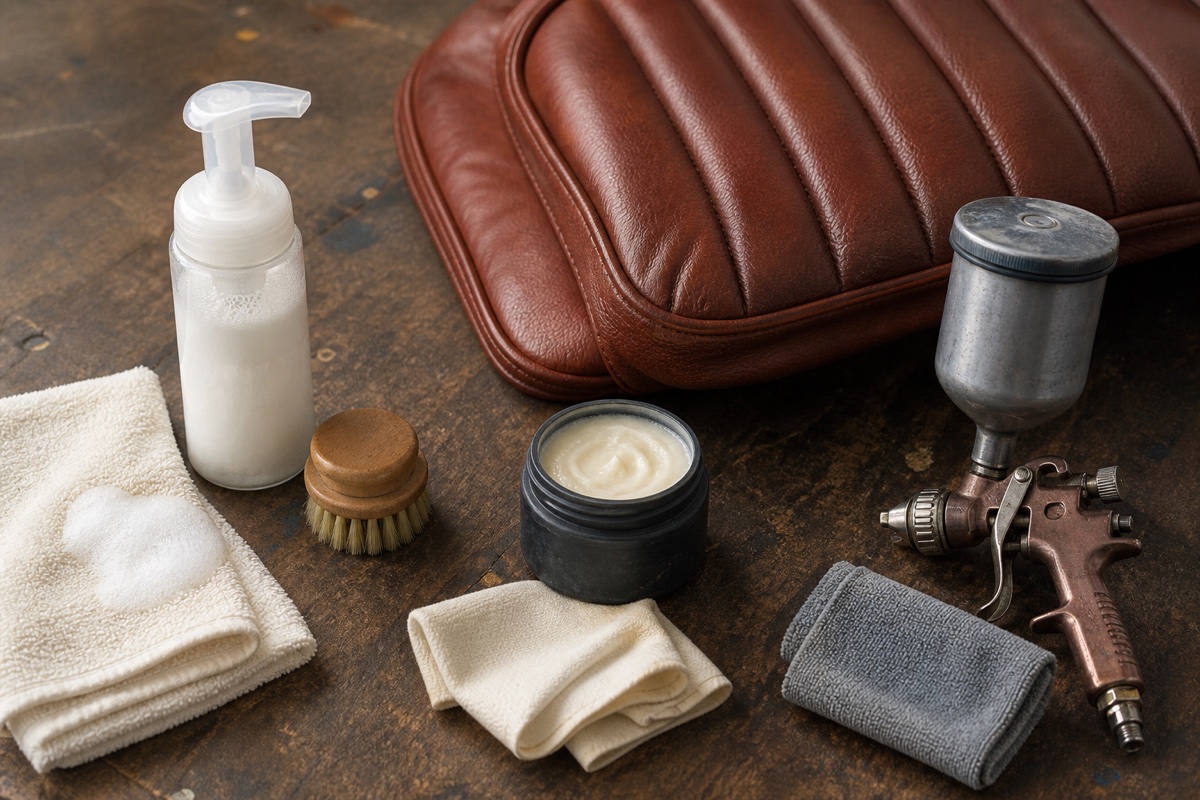
A cleaner addresses soil; a conditioner changes feel or replenishes selected properties; a finish changes protection, color or surface appearance. The material and existing finish decide whether any of them belong in the next step.
Read the product category, test on a hidden area and observe after drying. A good result immediately after application is not proof of long-term compatibility.
The safest shortlist starts with the symptom and finish, not with the strongest claim.
Start with the job, not the bottle
For the fuller treatment of that point, see practical guide.
Cleaner, conditioner and finish describe different roles. A cleaner lifts compatible soil or residue. A conditioner changes selected feel or care properties on a suitable leather. A finish creates or renews color, sheen and surface protection within a coating system. A label that combines all three words does not remove those distinctions. Begin by naming what changed on the item and which layer needs attention.
Use the Diagnostic Atlas to record material, finish, application and symptom. Dullness may be soil, abrasion or a naturally matte surface. A pale line may be finish loss rather than dryness. Tackiness may be residue or material degradation. Product selection cannot correct a diagnosis that has compressed every visible change into "needs feeding."
Read exclusions and technical instructions
Look for intended leather types, surfaces to avoid, application amount, residue removal, ventilation, drying and cure. Aniline, nubuck, suede, pigmented leather and vinyl do not share one test. A product presented for shoes may contain wax or pigment unsuitable for seating; an automotive coating system may require preparation and spray control far beyond ordinary home care.
Preserve the container and batch information when a surface reacts. Marketing words such as natural, premium and professional do not describe pH, solvent, oil, wax, pigment or polymer compatibility. When the maker provides a technical sheet, that document should guide the test. When it does not, the uncertainty belongs in the decision rather than being hidden by a confident recommendation.
Test and judge only after drying
Choose a hidden, intact and representative area. Use a clean applicator, the smallest useful amount and an untreated comparison. Avoid seams, cracks, perforations and edges. Record immediate color, then allow the specified drying or cure period before checking sheen, feel, odor and transfer. A temporarily dark, soft or glossy patch is not proof that the material has improved.
The product-test protocol is designed to answer one question at a time. If a cleaner changes color, do not add conditioner to hide it. If a conditioner leaves tack, do not seal it under finish. Stop, document and reassess. Stacking products removes the clean comparison that makes a small test useful.
Know when the role changes
Cleaning ends when compatible removable soil is gone or when the surface begins to move. Conditioning does not proceed over open coating, exposed substrate or unknown contamination. Refinishing begins only on stable material with a controlled preparation and a complete flexible color system. Structural tears, loose seams and weakened panels leave all three categories and enter repair or reupholstery.
Keep a simple item record: product, amount, area, date, drying time and observed result. It prevents accidental over-treatment and gives a technician evidence if later adhesion or color work is needed. A calm shortlist based on role and compatibility is more useful than a shelf of overlapping promises.
Source note: Leather Naturally. Accessed August 25, 2026.