Restoration trades • Repair & Restoration
Restoring Handmade Objects: Where Craft Repair Starts
Restoration of painted wood, amber, and textiles begins with identifying the original technique, not the damage. A practical guide to craft repair decisions.
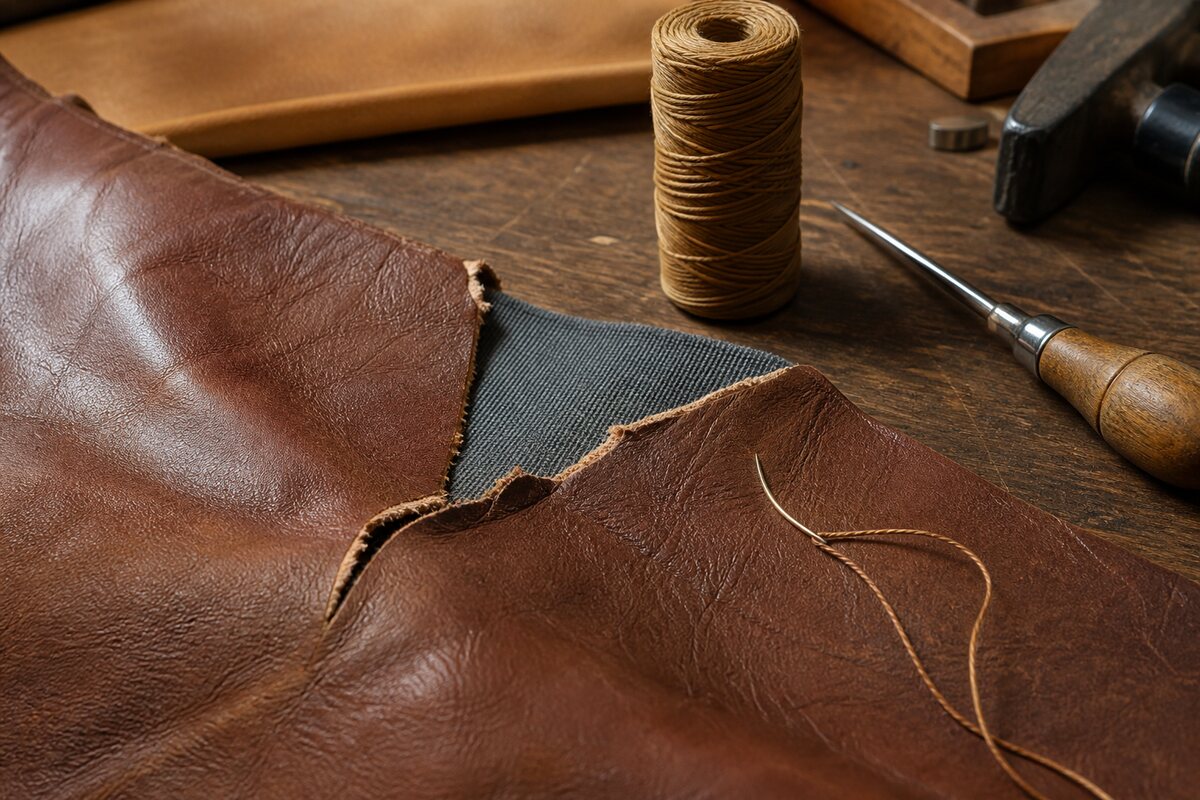
Restoration begins with identification, not repair.
Cleaning is the most common first instinct and the most common first mistake.
Reversibility is the principle that any intervention should be undoable without damaging the original material.
Why does identification come before any treatment?
Restoration begins with identification, not repair. Before any adhesive, solvent, or thread touches an object, the material and the technique that produced it have to be named, because a matryoshka turned from lime wood and finished with tempera behaves nothing like a lacquer miniature on papier-mache. The second rule is that reversibility outranks appearance: a repair that can be undone without loss is worth more than a seamless one that cannot.
A restorer working on Russian folk objects spends more time on attribution than on the bench. The reason is that the same visual symptom, flaking paint, a dull surface, a loose hinge, points to different causes depending on the school. A Sergiev Posad doll, carved with a rounded silhouette and painted in dense, opaque tempera, is a different substrate from a Semyonov doll turned with a distinct waist and finished in aniline dyes over a light ground. Treat the second as if it were the first and the solvent that lifts grime will also lift color.
The same logic applies across media. Khokhloma decoration is a painted surface on turned wood, sealed with a drying oil and often stoved, so its vulnerability is to abrasion and to heat, not to water alone. Gzhel porcelain is fired, glazed, and cobalt-decorated under the glaze, which means the decoration is protected and the risk sits in the glaze itself: chips, crazing, and the metal mounts that hold a piece upright. Zhostovo trays are painted on lacquered metal, and their failure mode is usually the lacquer layer, not the pigment beneath it.
A useful discipline is to write down what the object is before deciding what to do. Material, construction, finish, and date range, in that order. If any of the four is unknown, the correct next step is research, not treatment. For collectors who want a reference point on how these traditions are classified and described, a heritage guide to Russian craft, such as the one published at Russian craft traditions, is a reasonable place to check terminology before a bench session begins.
When is cleaning the wrong first move?
Cleaning is the most common first instinct and the most common first mistake. On amber, for instance, the surface is a fossil resin with a hardness between 2 and 3 on the Mohs scale, softer than most dust. Wiping a Baltic amber bead with a dry cloth can embed grit and produce fine scratches that read as cloudiness. The standard identification tests, brine flotation, ultraviolet fluorescence, and smell when warmed by friction, are diagnostic, not restorative, and none of them should be run on a piece that is already mounted or strung.
On painted wood, water is the danger. Tempera and distemper layers on a chalk or glue ground are hygroscopic. A damp cloth can swell the ground, lift the paint film at its edges, and leave a tide line that is far harder to correct than the original grime. The conservative sequence is dry first: soft brush, then a vacuum with a screen over the nozzle, then, only if the surface allows it, a minimally moistened swab tested on an inconspicuous area.
On textiles, the calculation is different again. A Pavlov Posad shawl with a printed wool ground and a woven border has two components with different dye fastness. A Vologda bobbin lace piece is a structure, not a surface: its integrity depends on the tension of the threads, and washing can relax that tension permanently. Orenburg down shawls, knitted from goat fiber, can felt irreversibly with heat and agitation. In all three cases, surface cleaning is a decision about the whole object, not about the stain.
What does reversibility mean in practice?
Reversibility is the principle that any intervention should be undoable without damaging the original material. It is easy to state and hard to follow, because the most reversible materials are often the least invisible.
In practice, reversibility shapes three choices. The first is adhesive: starch paste and certain synthetic resins can be softened later with water or a controlled solvent, while cyanoacrylate and epoxy cannot. The second is consolidation versus inpainting: stabilizing a lifting paint flake with a reversible adhesive preserves evidence, whereas filling and repainting the loss destroys it. The third is documentation: every material used, every area treated, and every photograph taken before and after. A repair without a record is a repair that the next custodian cannot safely reverse.
There is also a category of damage that should not be reversed at all. Patina on amber, the fine network of surface checks that develops over decades, is part of the object's history. Polishing it away to a high gloss resets the piece to an appearance it never had. The same applies to the wear on a samovar's tinned interior or the softened edges of a lacquered miniature: these are age, not fault.
How should copies and repairs be told apart?
Distinguishing an original from a later copy is a separate skill from restoration, but the two overlap, because a bad restoration often mimics the signals of a copy. On lacquered miniatures, the tell is usually the ground: authentic work shows a prepared papier-mache surface with a slight tooth under the paint, while reproductions frequently show a smooth, uniform base and printed or stenciled detail under magnification. On amber, the boundary between reconstituted and natural material is visible in the flow lines and in the behavior under ultraviolet light.
On textiles, the question is often about later alteration rather than outright forgery: a shawl border resewn, a lace piece assembled from two sources, a samovar fitted with a replacement handle. These are not deceptions by default, but they change what the object is, and they change what a restoration should preserve. The working rule is that any element added after the original making is documented as such, never blended in silently.
Which interventions should be refused?
Some requests should be declined, and a restorer who cannot say no is a risk to the object. Refuse to strip an original finish to reach a uniform color. Refuse to re-carve a missing element on a turned wooden figure, because the tool marks will not match and the loss is part of the record. Refuse to re-string amber beads onto a modern elastic cord if the original was knotted, unless the owner accepts that the object is being converted into jewelry rather than conserved.
Refuse, also, to treat an object whose material is still unidentified. This is the stop condition that matters most, and it is the one most often skipped under time pressure. Identification, documentation, a test on an inconspicuous area, and a reversible method: those four steps are the whole discipline. Everything else is technique.
What does a sensible restoration plan look like?
A workable plan fits on one page. It states what the object is, what is original, what is later, and what the owner wants from it. It separates stabilization, which stops further loss, from cosmetic work, which changes appearance, and it schedules stabilization first. It names the materials to be used and the method for reversing each one. It includes a condition report with photographs at a fixed scale and light angle, so that change can be measured later rather than remembered.
For collectors, the practical takeaway is that restoration is a decision about the future of an object, not a service to be purchased by the hour. The cheapest intervention is often the correct one: a stable environment, low light, stable humidity, handling with clean hands, and storage that does not compress or hang a fragile structure. Objects made by hand, whether a painted doll, a piece of amber, or a length of lace, were made to be used and seen. Keeping them that way, without erasing how they were made, is the whole aim.
Source note: Editorial method. Accessed August 25, 2026.