Grain vocabulary • Leather Types
What do grain terms tell you, and what do they not tell you?
Grain terms describe how a hide surface has been used or altered, but they do not by themselves establish durability, finish or care.
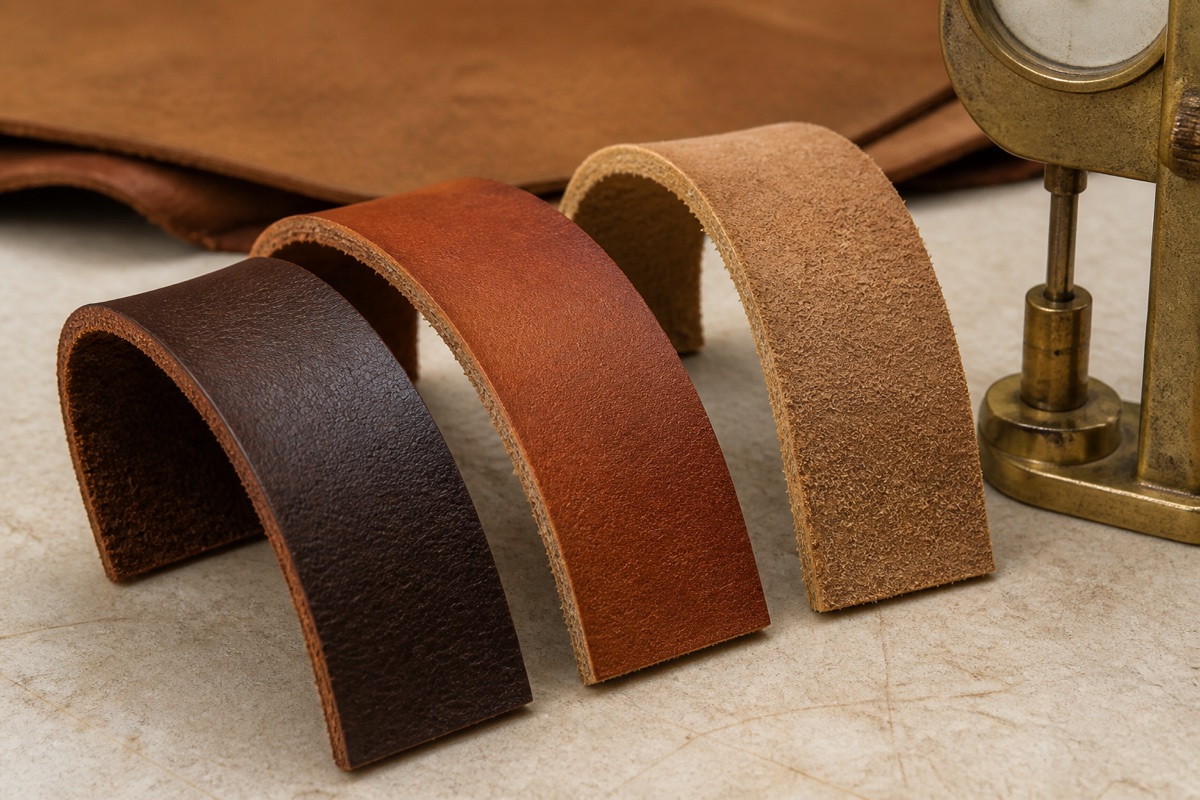
Full grain, top grain and split language needs application context. A heavily finished leather can be very practical, while a delicate natural surface can be beautiful and demanding.
Read the whole specification and ask about finish, thickness, backing and intended use.
Material literacy prevents a marketing adjective from becoming a treatment instruction.
Read grain terms as construction language
A related working question, treated at length, is leather dry-climate ranch house.
Full grain refers to leather using the grain surface without sanding away that top structure. Top grain is often used broadly for material from the upper layer and may include corrected surfaces. A split is the lower layer produced when a hide is divided through thickness. These terms describe which part and surface treatment are involved; they do not, on their own, state finish, thickness, workmanship or fitness for a particular use.
Terminology varies across sales pages, so ask for a complete specification rather than arguing from one adjective. The plain-English leather glossary links grain, corrected grain, nubuck, suede, pigmented and bonded terms. Reading them together prevents a layer description from being misused as a universal quality score.
Finish can dominate everyday behavior
Two top-layer leathers can behave very differently when one carries an open aniline finish and another has a robust pigment and topcoat system. A split can also be finished or coated for a specific product. Liquid response, abrasion visibility and care method therefore depend on the final surface and application as well as the hide layer. The grain term is only one field in the diagnosis.
Ask about finish type, coating, embossing, thickness, backing and intended use. For seating, include flex and cleanability; for bags, include edge construction and repeated handling; for vehicle trim, include heat and system requirements. The finish comparison supplies the surface context that grain vocabulary cannot provide alone.
Inspect a sample, not the visible face of an item
A retained offcut can show grain surface, flesh side, thickness and the character of a split edge. An installed object may hide those details beneath seams and backing. Do not cut, sand or peel a finished item to prove a marketing term. Use labels, supplier records and existing accessible edges, then state the confidence of the conclusion.
Natural markings can remain on full-grain leather, but their presence or absence is not a complete test. Embossing can add a pattern, correction can reduce visible defects, and careful selection can produce a uniform natural panel. Read several clues and preserve uncertainty when the evidence is incomplete.
Turn vocabulary into a buying question
Instead of asking whether full grain is always best, ask what surface, thickness and construction suit the object's use. A highly protected corrected leather can be practical in demanding seating. A minimally finished full-grain leather can offer expressive variation where the owner accepts careful maintenance. A split-based material can have a defined role when it is represented accurately and engineered for that role.
Keep the swatch, invoice specification and care instructions. If a seller cannot explain finish and application alongside the grain term, the missing information is itself useful. Material literacy does not force one purchase; it makes claims comparable and keeps future cleaning or repair from being chosen on prestige language alone.
Source note: Leather Naturally. Accessed August 25, 2026.