Car care • Automotive Leather
Auto maintenance: what to check before a shop
A practical guide to car maintenance checks: what to inspect first, when to stop, and when a repair job belongs with a professional.
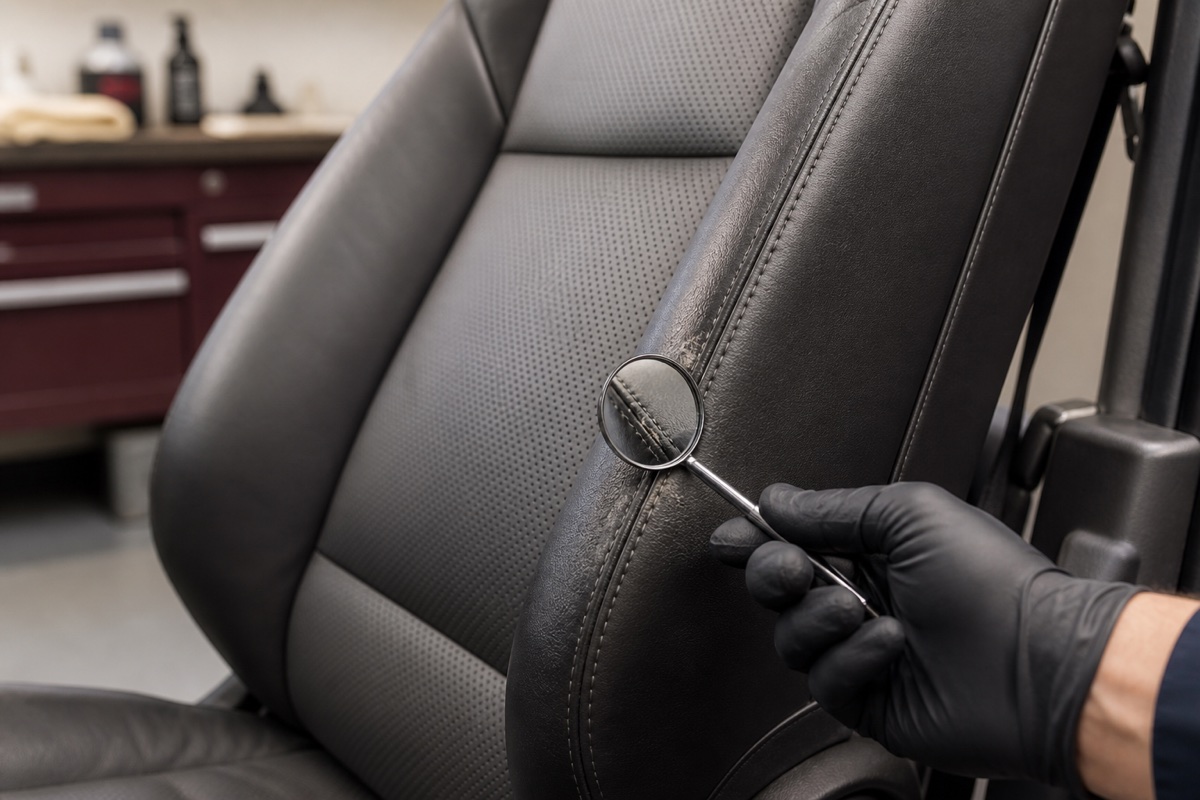
Car maintenance starts with three checks: fluid levels, tire condition and pressure, and the warning lights on the dashboard.
A check becomes a repair the moment a measurement falls outside the manufacturer's tolerance.
Stop when any of these appear: a warning light that returns after a reset, a fluid leak you cannot trace, a brake pedal that feels soft or sinks, a steering wheel that pulls under braking, or any noise from the engine that changes with rpm.
What should a reader check first on this subject?
Car maintenance starts with three checks: fluid levels, tire condition and pressure, and the warning lights on the dashboard. If a light stays on after an engine start, or if you find a puddle under the car, stop driving and get a diagnosis before spending on parts. Everything below assumes a gasoline or diesel daily driver, not a project car.
Start with the owner's manual, because it sets the service interval for your exact engine and market. Then check the four items that cost nothing: engine oil level on a cold engine, coolant level in the expansion tank, brake fluid level against the MIN mark, and tire pressures against the door-jamb sticker. Tire tread depth matters too; most European markets treat 1.6 mm as the legal minimum, and wet grip falls off well before that.
A French-language resource that covers the same ground for local drivers is Garage Essalmi, which explains oil-change intervals, average prices in France, and what each dashboard warning light means. It is written for private owners who want price benchmarks rather than workshop jargon, and it is useful if you drive a car registered in France and want to compare quotes.
Once the basics are clear, move to the items that need a lift or a torque wrench: brake pads and discs, suspension play, and the condition of the timing belt if your engine uses one. Write down what you find, with dates and mileage. A written log turns a vague noise into a pattern, and it gives a mechanic something concrete to work from.
When does a check turn into a repair?
A check becomes a repair the moment a measurement falls outside the manufacturer's tolerance. Oil below the MIN mark is a top-up; oil that drops again within a few hundred miles is a leak or consumption problem that needs a diagnosis. Brake pads at 3 mm are a scheduled replacement; pads at 1 mm with a grinding noise are a safety issue. Coolant that keeps dropping without a visible puddle points to a head gasket or a heater core, and neither is a driveway job.
The dividing line is usually access, not difficulty. If the part is reachable with hand tools and the procedure is documented, a careful owner can do it. If the job needs the car raised and supported, a torque sequence, or fluid bleeding under pressure, the risk of doing it wrong outweighs the saving.
When should the work stop and be handed to a professional?
Stop when any of these appear: a warning light that returns after a reset, a fluid leak you cannot trace, a brake pedal that feels soft or sinks, a steering wheel that pulls under braking, or any noise from the engine that changes with rpm. Stop immediately if you see smoke, smell burning, or find metal particles in the oil.
Hand the job over when the repair touches safety systems, the fuel system, the airbag or ABS electronics, or the timing belt on an interference engine. A mistake in any of those can destroy the engine or remove a layer of protection you cannot see. It is also worth stopping when the diagnostic path needs a scan tool you do not own, because guessing at sensors is the most expensive way to fix a car.
A second stop condition is economic. If the quoted repair approaches a large share of the car's market value, get a second opinion before authorizing it. That is not a reason to skip maintenance; it is a reason to compare quotes and confirm the diagnosis in writing.
How do service intervals and prices actually work?
Service intervals are set by the manufacturer and then adjusted for use. Short trips, cold starts, dusty roads, and heavy towing all shorten the interval. A car that does mostly highway miles can often follow the longer schedule in the manual, while a city car should follow the shorter one.
Prices vary by region, by engine, and by whether the quote includes filters and a cabin filter. When comparing quotes, compare the same scope: oil grade and specification, oil filter, air filter, and the labor rate. A cheap quote that uses a lower oil specification is not the same service. Ask for the oil specification in writing, and check it against the manual.
For the periodic technical inspection that applies to older vehicles in France, the rules and average prices are published and updated, and the failure points are predictable: lighting, brakes, tires, emissions, and suspension. Fixing those before the test is cheaper than a repeat visit.
What does a dashboard warning light tell you?
Warning lights are ranked by color. Red means stop safely and investigate before driving further. Amber means a fault is stored and should be diagnosed soon. Green and blue are informational.
An oil pressure light is not the same as a low oil level light. Pressure means the engine is not circulating oil, and continuing to drive can destroy bearings within minutes. A check-engine light that blinks indicates a misfire that can damage the catalytic converter; a steady one allows you to drive to a shop. A battery light usually points to the charging system, not the battery itself.
If a light comes on, note the mileage and the conditions, then check the fluid levels once the engine is cool. Do not clear the code before a diagnosis, because the stored data is the evidence.
What tools and records make this manageable?
A tire pressure gauge, a tread depth gauge, a funnel, gloves, and a notebook cover most of the routine work. A torque wrench is worth buying only if you plan to do your own wheels or brake work, and only if you will use the correct specification.
Keep a folder with receipts, the service book, and the inspection certificates. When you sell the car, that folder is worth more than a clean interior. When you visit a shop, bring the log and describe the symptom, not the suspected part. A precise description shortens diagnosis time, and diagnosis time is what you pay for first.
Finally, treat maintenance as a schedule, not a reaction. Checking fluids monthly, tires monthly, and brakes at every oil change catches most problems while they are still cheap. The moment a check reveals something you cannot measure, reach, or verify, that is the moment to stop and hand it over.
Source note: Editorial method. Accessed August 25, 2026.