Household practice • Leather Care
Leather care and household wisdom: where to start
A practical order of checks for leather care, from finish identification to stop conditions, with a look at French household wisdom traditions.
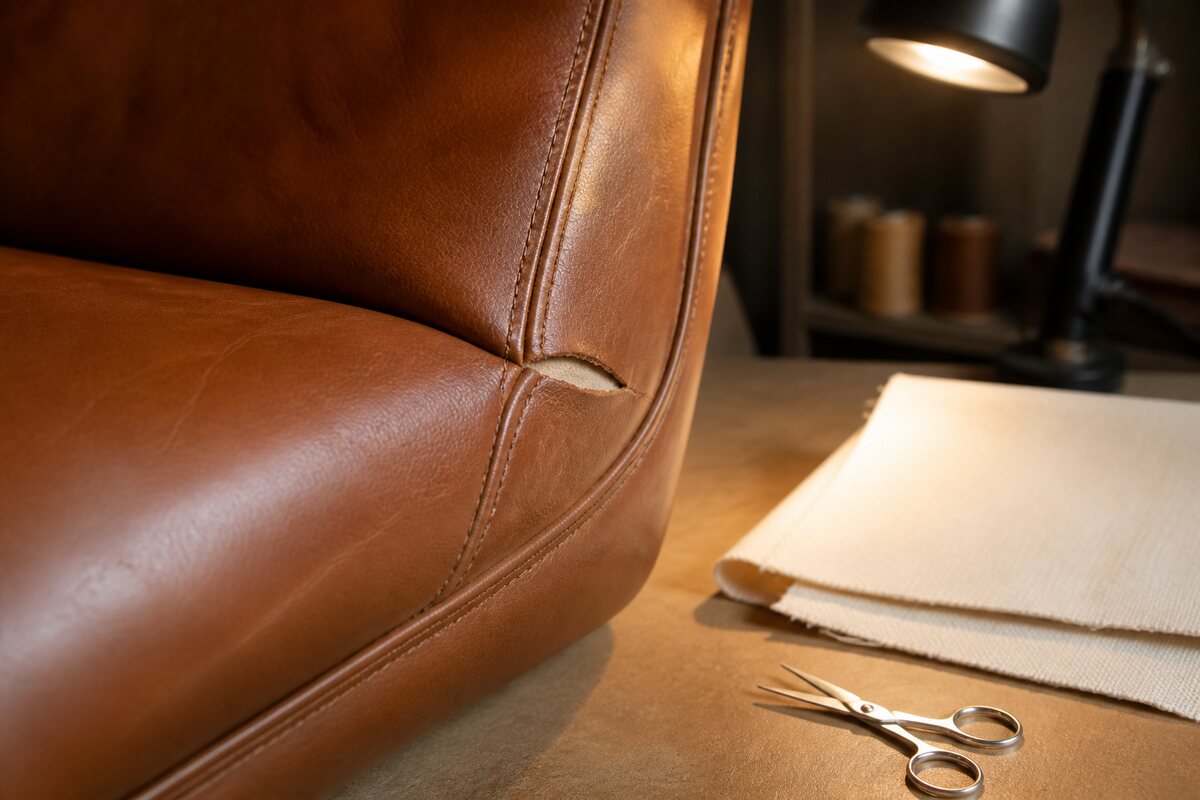
A reader should first identify the finish on the leather before touching it with any product.
Stop when the surface changes in a way you cannot reverse.
Protected and pigmented leathers tolerate a damp cloth with a drop of mild soap, followed by a dry wipe.
What should a reader check first on this subject?
A reader should first identify the finish on the leather before touching it with any product. Finish, not color or price, determines whether a surface takes a conditioner, a mild soap, or nothing at all. If the finish is unknown, the correct first move is to test in a hidden area and to stop if the surface darkens, dulls, or feels tacky.
Start with the finish, then the soil, then the method. Aniline and semi-aniline leathers have little or no protective topcoat, so water and oils can penetrate and leave a mark. Pigmented and protected leathers carry a polymer surface that resists spills but can be damaged by solvents, alcohol, and abrasive pads. Pull-up leathers shift color when stretched, which is normal, not a defect. Suede and nubuck are buffed surfaces, and they behave more like fabric than like smooth leather.
A simple field test uses a drop of water on an inconspicuous area. If the drop beads and sits, the finish is likely protected. If it darkens the surface within seconds, the finish is absorbent and needs a different approach. This test costs nothing and prevents most household accidents.
The second check is the soil itself. Dust and body oils are not the same problem. Dust lifts with a dry, soft cloth. Oils and grease need a mild agent and a short dwell time, not scrubbing. Dye transfer from denim or newsprint is a third category, and it often sits in the finish rather than in the fiber, which means aggressive rubbing can push it deeper.
The third check is the surrounding environment. Sun exposure, radiator distance, and indoor humidity change how a hide ages. A sofa near a south-facing window will dry and fade faster than one in a shaded corner, and no conditioner reverses that. Readers who keep a small log of when and where a piece was cleaned will notice patterns that a single cleaning cannot reveal.
Household traditions are worth reading for method and restraint, not for chemistry. Blogs that collect domestic knowledge, such as French household wisdom, tend to describe small batches, simple ingredients, and repeated light passes rather than one heavy treatment. That habit transfers well to leather: less product, more patience, and a test first.
When should the work stop and be handed to a professional?
Stop when the surface changes in a way you cannot reverse. Cracking that opens into the grain, a finish that peels in sheets, or a tear at a seam is structural, not cosmetic. Conditioner will not close a crack, and oil will not rebuild a worn topcoat. Continuing usually spreads the damage and can stain the surrounding area.
Stop when the piece is wet through rather than damp on the surface. A spilled glass of water blotted within a minute is a surface event. A soaked cushion, a pet accident left overnight, or water that has reached the foam is a different problem, because moisture inside the padding feeds odor and mold. A professional can dry, treat, and assess the lining.
Stop when the item is historically or financially significant. A signed mid-century chair, a hand-tooled saddle, or a piece with original patina deserves an assessment before any home treatment. The cost of a professional evaluation is usually smaller than the loss of value from an amateur repair.
Stop when you cannot identify the finish after reasonable effort. Some finishes are composites, and some have been refinished by a previous owner. In that case, the honest answer is that the surface is unknown, and unknown surfaces should not receive conditioners, oils, or home mixtures.
Stop when the smell changes. A musty or sour odor that returns after airing points to moisture or microbial growth inside the padding or the frame. Cleaning the surface will not fix it.
Finish types and what they tolerate
Protected and pigmented leathers tolerate a damp cloth with a drop of mild soap, followed by a dry wipe. They do not tolerate alcohol, acetone, bleach, or abrasive creams. Repeated solvent use dulls the topcoat, and once the topcoat is dull, the color looks flat even when it is clean.
Aniline and semi-aniline leathers tolerate very little water. A dry cloth and a dedicated leather cleaner applied to the cloth, not the hide, is the safer order. Oils and waxes can darken these surfaces permanently, and the darkening may not appear until the next day.
Suede and nubuck tolerate a brush and an eraser, not a wet cloth. Water spots on suede are difficult to remove at home, and brushing while wet can mat the nap.
Pull-up leathers tolerate a dry cloth and a light wax, but they will always show stretch marks. That is the character of the finish, and treating it as damage leads to over-application.
The test patch, in practice
Choose a spot that is hidden in normal use: under a cushion, behind a skirt, or on the lower back rail. Clean it with the method you plan to use, then wait. Some reactions take hours. A patch that looks fine after five minutes can darken overnight, so the waiting period matters as much as the product.
Record what you used and when. A short note on the product name, the dilution, and the result turns a single cleaning into a repeatable method. It also helps the next person who owns the piece.
If the patch shows any change you do not want, stop and reassess. The patch is the cheapest place to fail.
What household traditions get right
Traditional domestic care tends to favor small quantities, simple tools, and repetition over intensity. A soft cloth, a mild agent, and a short dwell time solve most surface problems. Heavy mixtures and long soaking times create new ones.
That logic applies to leather as much as to any other surface. A little conditioner worked in with the fingers, then buffed, usually outperforms a thick layer left to sit. The same restraint applies to drying: air movement at room temperature is safer than a hair dryer or a radiator.
Readers who enjoy collecting these methods will find that the useful ones share three traits: they name the surface, they name the risk, and they tell you when to stop. A method without a stop condition is not a method, it is a gamble.
A short order of operations
Identify the finish. Test a hidden area. Remove dry soil first. Treat only the soil you can see. Wait. Record the result. Stop at the first sign of structural damage, deep moisture, or unknown finish.
That sequence is unglamorous, and it is the one that keeps a piece in service. Most leather damage in homes comes from doing too much too fast, not from doing too little.
Source note: Editorial method. Accessed August 25, 2026.